
Watch a quick walkthrough or book a demo
Request successful.
Our team will contact you within one business day.
Pick a time that works for you and we'll send the invite.
Oops! Something went wrong while submitting the form.
Sign-up successful!
Check your inbox for a link to activate your free Perdoo account.


Henrik van der Pol
6
min
read
Key Takeaway: Most KPI dashboards show what happened but never answer "what do we do next?" A playbook dashboard ties KPIs to OKRs and Initiatives, assigns pre-agreed actions to close gaps, and gives leaders a single view of what's off track and who owns the fix. Here's how to build one.
Every leadership team I've worked with has dashboards. Usually too many of them. They’re full of KPIs like revenue, churn, pipeline velocity, NPS, you name it. And in most cases, they don't change how decisions get made.
According to Oracle's Decision Dilemma study, 77% of business leaders say the dashboards and charts they get don't relate directly to the decisions they need to make. Meanwhile, 72% admit that data volume has stopped them from making any decision at all.
I've seen this with many customers. A Head of Ops opens a quarterly review with a 20-slides deck of KPI charts. Everyone nods. Nobody knows which number is actually a problem, what caused it, or who should do something about it. The meeting ends with a vague commitment to "look into it." Three months later, same charts, same conversation.
Why traditional KPI dashboards fail strategy execution
The core issue is that most dashboards are built to display data, not to drive action. They answer "what happened?" but skip the two questions leaders care about: "what's off track?" and "what do we do next?"
KPIs live in isolation from strategy
Teams track metrics because they can, not because those metrics connect to a Strategic Pillar or Objective. When your Marketing team monitors 23 KPIs and your Sales team monitors 18, you end up with data that's comprehensive but strategically meaningless. In my experience, the companies that struggle most with execution aren't lacking data. They're drowning in metrics that don't ladder up to anything.
No thresholds, no urgency
A KPI sitting at 4.2% means nothing unless you know whether it should be at 3% or 6%. Without targets and health thresholds, dashboards become passive observation tools. Data from Dataversity shows that 60% of BI initiatives fail to deliver business value, and weak governance is a major contributor.
No pre-agreed response when things go wrong
Even when a dashboard surfaces a problem, there's no playbook for what happens next. Who reviews it? Who decides? Who acts? As Spider Strategies notes, "every KPI threshold crossing needs a pre-defined response protocol." Without one, leaders spend review meetings diagnosing problems that should have been triaged weeks ago.
What a playbook dashboard actually is
The concept comes from Oliver Wight's work on strategy execution. A playbook dashboard combines two things that traditional dashboards keep separate:
- A visual rollup of KPIs tied directly to your strategy, showing health status at a glance.
- An inventory of pre-agreed, best-practice actions for closing gaps when things go off track.
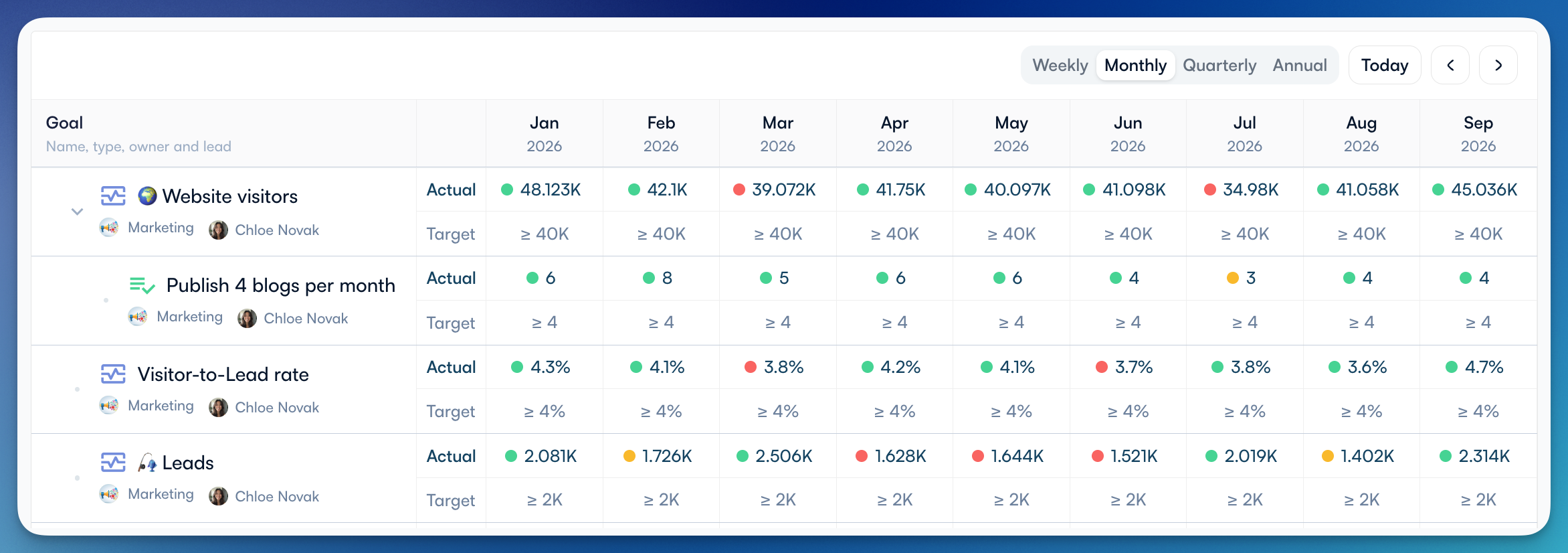
A regular dashboard says "revenue retention is at 91%." A playbook dashboard says "revenue retention is at 91% against a target of 95%, the gap is widening, and the pre-agreed response is to trigger a churn analysis OKR owned by the CS team lead." One is information. The other is a decision-ready system.
This is exactly why KPIs and KPI dashboards in Perdoo are so much more powerful than in any other software.
How to build a playbook dashboard that drives execution
I think you need four layers to make this work. Skip any of them and you'll end up with another pretty reporting surface.
Layer 1: Connect every KPI to your strategy
Start by auditing your current KPIs. For each one, ask: "which Strategic Pillar does this contribute to?" If a KPI doesn't connect to a Strategic Pillar, it's either misplaced or unnecessary.
While you can definitely have a number of KPIs that don't align directly with strategy, in practice this often means cutting. I've seen with many customers that linking KPIs to Strategic Pillars alone reduces the number of tracked metrics by 30 to 50%, because it forces honest conversations about what actually matters. If a metric doesn't have a home in your strategy, archive it.
Layer 2: Set explicit health thresholds
Every KPI needs a target value and a clear definition of healthy versus unhealthy. This is what turns a passive chart into an active signal.
For example:
- Gross Monthly Churn ≤ 2%
- Employee NPS ≥ 30
- Lead-to-Customer Conversion Rate ≥ 5%
When a KPI crosses from healthy to unhealthy, the dashboard should make that impossible to miss. No one should have to squint at a trend line to figure out whether something needs attention.
Layer 3: Pre-agree on gap-closing actions
This is where the "playbook" part comes in, and where most organizations have nothing in place.
For every critical KPI, document in advance:
- What triggers action: the specific threshold or trend that moves a KPI from "monitor" to "act."
- Who owns the response: not a department, a person. Accountability needs a name attached to it.
- What the default first response is: usually creating an OKR to diagnose and fix the root cause.
- The escalation path: if the first response doesn't move the KPI within a defined timeframe, what happens next?
When a KPI goes unhealthy, it needs work. You can improve a KPI through OKRs or Initiatives. These goals have a clear owner and a lead. The KPI tells you something is broken. The OKR or Initiative is how you fix it.
For instance, if your customer satisfaction KPI drops below target, the pre-agreed action might be: "CS team lead creates an OKR within one week to identify the top three drivers of dissatisfaction and implement fixes within the quarter." Compare that to the typical response, which is a discussion in the next leadership meeting, maybe.
Layer 4: Build a review rhythm around the dashboard
A playbook dashboard only works if it's embedded in how you run the business. I think you need something tighter than monthly planning cycles for most SMBs:
- Weekly: 15-minute team check-in focused on KPI health. No slides, just the dashboard. If something is red, confirm the response action is underway.
- Monthly: cross-functional review. Look at KPI trends, OKR progress on any gap-closing efforts, and whether any pre-agreed actions need to be revised.
- Quarterly: strategic reassessment. Are we tracking the right KPIs? Have our thresholds changed? Do any playbook actions need updating based on what we learned?
Leaders should walk into these meetings already looking at the same dashboard. If the first half of every review is spent establishing shared facts, you've already lost.
A practical example
Let's say your company has a Strategic Pillar called "Build a world-class customer experience." Three KPIs measure its health:
In a traditional dashboard, two unhealthy KPIs would prompt a discussion. In a playbook dashboard, the actions are already defined:
- CSAT at 7.9: pre-agreed action is that the CS team lead creates an OKR: "Identify and resolve the top 3 drivers of customer dissatisfaction this quarter." Key Results might include "Conduct 30 customer interviews by week 4" and "Implement fixes for the #1 driver by end of quarter."
- Churn at 2.4%: pre-agreed action is that the Head of Product creates an OKR: "Reduce churn to ≤ 2% by end of quarter." Key Results might include "Increase activation rate for new customers to 80%" and "Launch proactive outreach program for at-risk accounts."
Because these actions were agreed on before the crisis, there's no debate about whether to act or who should do it.
What makes this different from just combining KPIs and OKRs
Most teams have KPIs. Most teams have OKRs. Very few teams have pre-agreed protocols for how an unhealthy KPI triggers a specific OKR or Initiative. That protocol is the playbook layer, and it's what turns a dashboard from a reporting surface into an execution system.
Without it, you rely on someone noticing the problem, bringing it up, getting approval to act, assembling a team, and defining what success looks like. That process takes weeks. With a playbook, the response is already loaded. According to industry research, a problem detected in week two might require a minor course correction, while the same problem discovered in week ten becomes a major organizational intervention. The playbook dashboard collapses that detection-to-action gap.
Build playbook dashboards with Perdoo
A playbook dashboard connects the KPIs you track to the action your team needs to take. Perdoo brings your KPIs, OKRs, Initiatives, and Tasks together so you can spot an unhealthy KPI, set an OKR or Initative to improve it, and track the work that will get it back on course. Your dashboard becomes the starting point for decisions, ownership, and follow-through.
Build your first playbook dashboard with your most critical KPIs. Give each one an owner and a target, agree on what you’ll do if it goes off track, and review progress with your team each week.
Ready to put your playbook into practice? Create a free Perdoo account and bring your KPIs and response plans into one place. Start for free or request a demo to explore it with our team.

Ready to get started?
Free for up to 5 people.